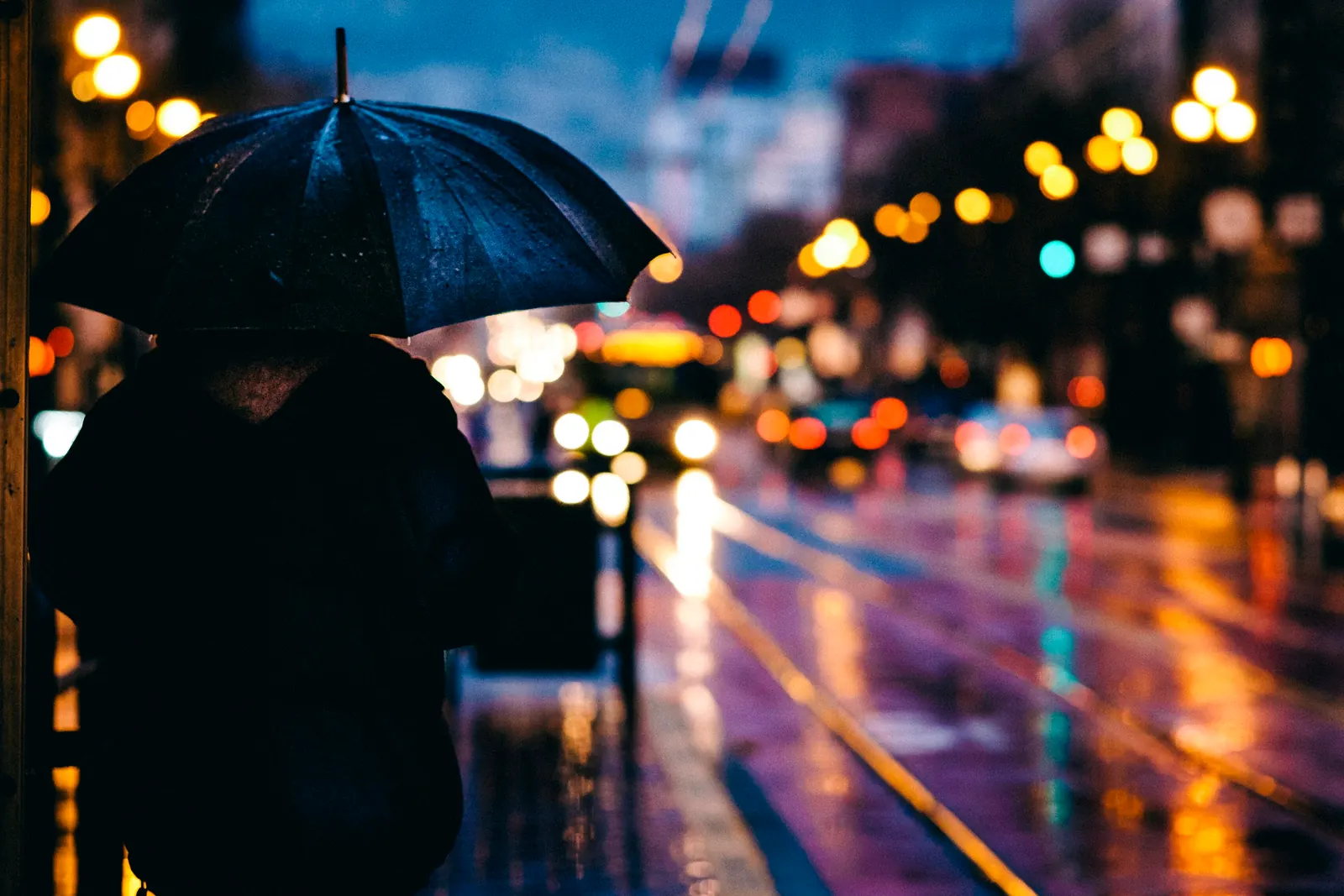
Search for what to do on a rainy day while travelling and you get a list: museums, covered markets, a long lunch. The list is fine, and it is not the hard part. The hard part is that the rain lands on a day you have already planned, in a neighbourhood you have already chosen, sometimes with a ticket already paid for. A plan B is not a list of indoor places. It is a way of changing that day without wrecking the rest of the trip.
A plan B made at breakfast is a scramble. A plan B made before you leave is a swap.
Read the forecast before you change anything
“60% chance of rain” is the number people react to, and on its own it says very little. It does not mean rain for 60% of the day, and it says nothing about how much. Before you rearrange a day, look at three things in the hourly forecast:
- When. Rain from nine to eleven is a late start, not a lost day.
- How much. A millimetre or two an hour is an umbrella. Several millimetres an hour, all afternoon, is a different day.
- What kind. Scattered showers come and go; a front that settles in tends to stay until it has passed.
Make the call the evening before, not three days out: beyond a couple of days, a forecast for one particular place and hour is rough. That gives you three honest options. Steady rain all day: swap the day. Showers: keep the day and reorder it. Drizzle: take a jacket and carry on.
Only some of the plan needs a plan B
Go through the itinerary once and give every stop one of three labels. This takes ten minutes and it is the whole of the preparation:
- Rainproof. Museums, market halls, churches, a meal, a concert. Rain changes nothing, apart from how many people had the same idea.
- Worse, but still worth it. An old-town walk, a street market under awnings, a neighbourhood with arcades. Wet streets are quieter, and some cities look their best in rain.
- Pointless in rain. Viewpoints, beaches, parks and gardens, boat trips, rooftop bars, anything that exists for the view.
Only the third group needs an alternative. On most city trips that is a handful of stops, not half the plan.
How to build a rainy day plan: swap days, do not cancel them
The best plan B for a rainy day is usually another day of your own trip. If Thursday is the park, the viewpoint and the walk along the river, and Friday is the museum quarter and the market hall, a wet Thursday is solved by swapping them. Nothing is lost; it just happens in a different order.
That only works if the trip has days of different kinds to swap, which is one more reason not to build every day the same way. Before swapping, check two things:
- Fixed bookings. A timed ticket or a table on either day pins it in place.
- Closing days. The museum day you are pulling forward may land on the day it shuts. This is the most common way a swap fails, and the one most worth checking: half the museums are shut on Monday, and some close on other days too.
Put the weather-dependent things early in the trip when you can. A viewpoint planned for the last evening has nowhere to go if that evening is grey; planned for day two, it has three days to be moved into.
Keep the alternative in the same neighbourhood
When swapping is not possible, replace stop by stop, and keep each replacement close to the stop it replaces. Rain makes moving around worse than usual: buses are full, taxis are hard to find, and a fifteen-minute walk becomes a soaked fifteen minutes. A plan B that sends you across the city has cost you the morning before it starts.
So for each “pointless in rain” stop, note one indoor option within a short walk of it. If the day was built by neighbourhood, this is easy: the area you were going to be in anyway has a covered market, a smaller museum or a long lunch in it.
Everybody has the same plan B
On the first wet morning of a busy season, the city’s best-known museum fills up with everyone who had planned to be outside. Queues that are twenty minutes on a sunny day can stretch much longer, and the galleries are slower to walk through.
- Go at opening time. The rush builds as people look out of the window and change their minds.
- Book the evening before if the place sells timed entry. Once the rain starts, the slots go.
- Choose the second museum. A smaller collection, a house museum or a local history museum is often the better visit on a crowded day, and it is not where everyone else is going.
Book weather-dependent things with an exit
The rain does most damage to things you paid for in advance. Before booking anything that only makes sense in good weather, such as a boat trip, an observation deck at sunset or an outdoor tour, read what happens if it rains.
Where there is a choice, take the flexible ticket, or book close to the date, when the forecast means something. And keep at least one day free of fixed bookings: it is the day everything else can move into.
What works well in the rain, beyond museums
Museums are the obvious answer and often the right one. They are not the only one, and a whole wet day of galleries is tiring in its own way. Other things that rain does not spoil:
- A covered market or food hall, done slowly, with lunch inside it.
- The long lunch at the restaurant you had marked as “if there is time”.
- Public baths or a spa, where they are part of the local life.
- Covered arcades and passages, historic libraries, reading rooms and old cafés.
- A matinee concert, a cooking class or a workshop you can join at short notice.
- An afternoon off: laundry, a nap, and a look at the days still to come.
An example: three days, one wet one
A three-day city trip. Day one: the old town and the cathedral. Day two: the park, a viewpoint at the top of the hill, and a walk along the river at sunset. Day three: the museum quarter and the market hall. The evening before day two, the forecast shows steady rain from morning to mid-afternoon, clearing after five.
Day three has no bookings, and its museum is open on day two, so the days swap: the museum quarter and the market hall move to the wet day, with the main museum at opening time. The park moves to day three. The viewpoint, the only stop that really needs a clear sky, goes to the end of the new day two, since the evening is forecast dry, with day three’s evening as its fallback. Nothing has been dropped, and the whole change took a few minutes over dinner.
Making the change on the go
Whatever you plan with, the useful habit is the same: look at tomorrow’s forecast each evening and adjust one day at a time. If your trip is in Traveley, the plan already takes the season into account when you give it dates, and on the trip itself you can ask for a tweak in your own words, such as “tomorrow it rains, swap the outdoor stops for indoor ones nearby”, or change the stops yourself by hand without using a tweak.
Either way, the rain stops being the thing that ruined Thursday and becomes the reason Thursday and Friday swapped places.
Let Traveley plan the days
Tell it where you are going and it builds the whole trip — free to start, no account needed.
Get it on Google Play